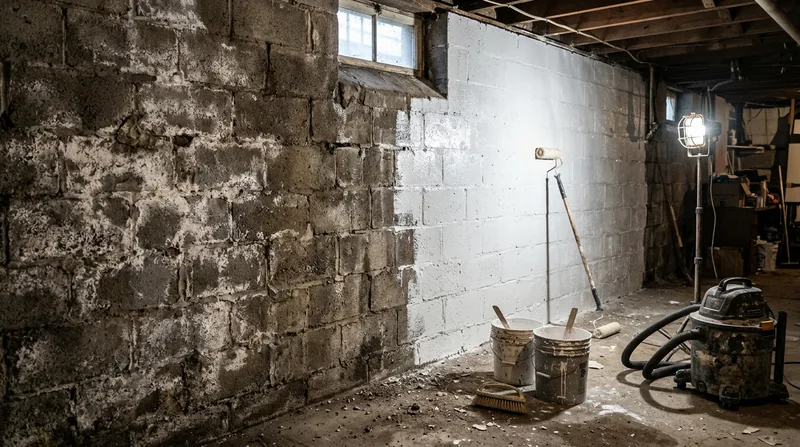




Basement Wall Sealing in Paterson: Stop the Damp Before It Spreads
Paterson sits in a bowl of traprock slopes and glacial clay, wrapped around the Great Falls and the bends of the Passaic River below Garret Mountain. That geology matters to every homeowner in the Dublin and Sandy Hill sections, where 1850s to 1910s brick rowhouses sit on red brownstone and old lime mortar foundations that have been wicking groundwater for a century. If your basement walls feel damp, show white chalky bloom, or smell musty after a nor'easter, Basement Wall Sealing in Paterson is the first diagnostic step, not the last. We seal damp walls, remove efflorescence, and tell you honestly whether a sealer will solve your problem or whether hydrostatic pressure is pushing water through and you need full basement waterproofing instead.
Why Paterson Basements Take On Water: Clay, Traprock, and Old Brick
Paterson's soil is a mix of glacial lake clay and silt with a shallow water table, and that clay holds water like a sponge against your foundation. On the Eastside Park mansions and the Riverside three-families, we routinely find original brick foundations with lime mortar that has softened over decades of freeze-thaw cycles. When the ground saturates during a spring melt or an Ida-style tropical downpour, hydrostatic pressure builds and finds every weak point: mortar joints, tie holes, hairline cracks, and porous brick faces.
- Damp walls and white efflorescence on brick foundations in the Dublin and Sandy Hill sections point to capillary suction through old mortar.
- Peeling paint and chalky white powder on block walls in Hillcrest and Haledon Capes usually means moisture is migrating through the block cores.
- Water seeping at the wall-floor joint after heavy rain in Wayne and Fair Lawn split-levels often signals a drain tile problem, not just a damp wall surface.
- Musty odors in South Paterson and Totowa section basements track with high humidity and persistent wall dampness, not always with visible water.
Sealing is the right first move when the wall is damp but not actively leaking under pressure. When water runs, we look deeper.
Key info: On a 1905 brick rowhouse near the Great Falls, we found efflorescence from the floor to four feet up, but no running water. A penetrating sealer and repointed mortar joints solved it. Two blocks away, a homeowner had the same white bloom but water was pooling at the cove joint after every storm. That one needed an interior drain tile system, not a sealer.
For official guidance on construction and alteration permits in Paterson, the city's construction office at patersonnj.gov is the authority to check before any structural work begins.
How We Seal Basement Walls in Paterson, Step by Step
Wall sealing is not a paint job. We start by identifying what is actually happening: capillary suction through porous masonry, vapor transmission through block, or active hydrostatic seepage. Each one calls for a different surface preparation and a different sealer. On the 1940s block basements in Haledon and the poured walls in Wayne, the prep work is where the job succeeds or fails.
- We inspect the wall for cracks, efflorescence, and moisture readings, and we check the wall-floor joint for active seepage.
- We remove efflorescence with a dry brush and a mild acid wash, then rinse and let the masonry dry to a stable moisture level.
- We scrape loose paint, patch spalled mortar and honeycombed block, and grind out any active crack for proper filling.
- We apply the correct sealer: a penetrating silane-siloxane for brick and block that needs to breathe, or a cementitious membrane for walls with active vapor transmission.
- We verify coverage, check the wall-floor joint, and document the moisture readings before and after.
If we find an active crack during prep, we stop and recommend foundation crack repair before sealing, because sealer over a moving crack will fail within a season.
Key info: A Prospect Park homeowner called us after a sealer from a big-box store peeled off within six months. The wall had active efflorescence and a hairline crack at the cove joint. We removed the failed coating, treated the efflorescence, injected the crack, and then sealed. Two winters later, the wall is dry.
Sealing Approaches We Use on Paterson Basement Walls
Not every damp wall needs the same product. The right choice depends on the masonry type, the moisture source, and whether the wall needs to release vapor or block it. Here is how we match the approach to the wall.
| Approach | Description | Best for |
|---|---|---|
| Penetrating silane-siloxane sealer | Soaks into brick and block pores and repels water while letting the wall breathe. | Damp brick and block walls with efflorescence but no running water. |
| Cementitious waterproof membrane | A troweled or brushed coating that blocks vapor transmission and fills surface pores. | Poured and block walls with active vapor drive and dampness. |
| Crystalline waterproofing | A reactive treatment that grows crystals into cracks and capillaries to seal them from inside. | Hairline cracks and porous concrete where a coating would peel. |
| Epoxy or polyurethane injection | Ports drilled along a crack and resin injected to fill it solid. | Active cracks that sealer alone will not stop. |
| Parging and mortar repair | Replacing spalled mortar and soft brick faces before any sealer goes on. | Old brick foundations with deteriorated lime mortar. |
We choose the method after a moisture reading, not before. That is the difference between a sealer that lasts and one that peels by spring.
Basement Wall Sealing Cost in Paterson: What to Expect
Pricing for wall sealing in Paterson starts from $1,500 for a straightforward damp wall with efflorescence and no active water. That figure covers surface prep, efflorescence removal, and sealer application on a typical basement wall run. What moves the number up is the condition of the wall, not the square footage alone.
- Heavy efflorescence and failed coatings add prep time, because we have to strip and neutralize before sealing.
- Spalled mortar or soft brick faces require parging first, which is a separate repair step.
- Active cracks need injection before sealing, and that is priced per crack.
- Access matters: a finished basement with paneling and stored belongings takes longer to protect and work around.
- High humidity or active seepage may mean the wall needs an interior drain tile system, which is a different scope.
Get two or three written estimates and make sure each one states what happens if active water is found during prep. For a fuller breakdown of how we price sealing and related work, see our pricing overview.
Choosing a Basement Wall Sealing Contractor Near Me in Paterson
Paterson has no shortage of contractors who will paint a sealer on a wet wall and cash the check. The ones worth hiring do three things: they read the wall before they quote, they carry insurance, and they tell you when sealing is not the answer. Ask for a certificate of insurance and a reference from a job in your section of the city, not from three towns away.
- Confirm the contractor is licensed and insured for residential waterproofing work in New Jersey.
- Get two or three written estimates that specify products, prep steps, and what happens if active water is found.
- Ask for references from Paterson, Clifton, or Passaic jobs on similar masonry, because brick and block behave differently.
- Ask whether a permit is required for any structural repair or drainage alteration, and verify with the local building department.
- Check that the contract states a transferable warranty in writing, not a verbal promise.
If a contractor quotes a sealer without checking moisture or looking for cracks, keep calling. You can reach us for a free basement inspection at our contact page.
When Sealing Is Not Enough: Reading the Signs in a Paterson Basement
Sealer is a surface treatment, and surface treatments do not stop hydrostatic pressure. If water is running at the wall-floor joint during a nor'easter, or if the wall bows inward, sealing will fail and you will have wasted the money. In the traprock slopes below Garret Mountain and the clay flats near the river, pressure builds fast during spring melt and heavy rain. That is when we recommend an interior drain tile system to relieve the pressure at the footing instead of fighting it at the wall face.
If the wall is damp but stable, sealing is the right call. If it is wet, bowed, or leaking at the cove joint, we tell you so before you spend a dollar on sealer. That is the honest guidance you should expect from a dedicated basement waterproofing specialist.
Basement Wall Sealing in Paterson: Pricing Guide
| Service | Price | Details |
|---|---|---|
| Single wall damp sealing | Starting at $1,500 | Includes efflorescence removal, surface prep, and penetrating sealer on one wall run. |
| Full basement wall sealing | Starting at $2,800 | Covers all accessible walls, with prep and sealer; price rises with wall length and condition. |
| Sealing with crack injection | Starting at $2,200 | Adds epoxy or polyurethane injection for active cracks found during prep, priced per crack. |
| Masonry repair and parging | On estimate | Spalled mortar and soft brick need an on-site look before we quote the repair scope. |
| Travel | Included | In Paterson and surrounding areas, no separate call-out or mileage fee. |
| Estimate | Free | Response within 24 hours at (862) 420-0796, no obligation to book. |
Indicative pricing, the exact cost depends on square footage, finish, and site access. Free personalized estimate within 24h at (862) 420-0796.


