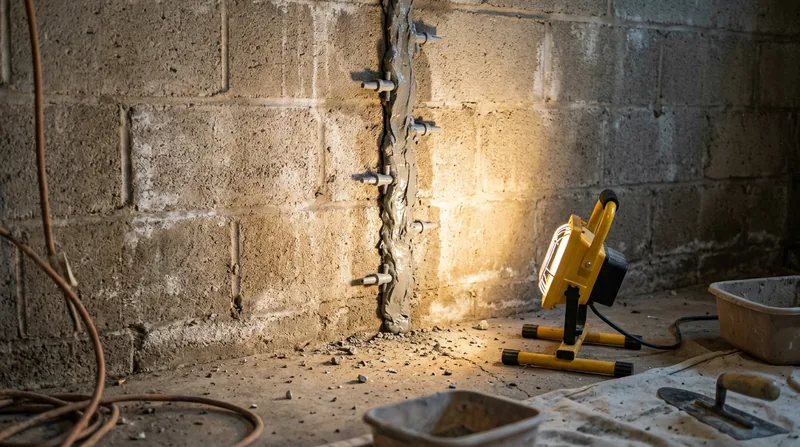




Foundation Crack Repair in Paterson: Where Old Brick Meets Glacial Clay
Paterson sits in a bowl of glacial lake clay and silt below Garret Mountain, and the Passaic River bends right through it. That geology matters. Clay holds water against your foundation instead of letting it drain away, and the traprock slopes above the Eastside Park and Hillcrest neighborhoods shed runoff downhill fast. When we do Foundation Crack Repair in Paterson, we are usually dealing with a 100-year-old brick foundation on lime mortar, or a poured basement from the 1950s onward that has finally cracked under hydrostatic pressure.
We are a dedicated below-grade specialist, not a general foundation firm and not a plumber. That distinction keeps our focus on the crack itself, the water behind it, and whether injection alone will hold or whether the wall is telling you something bigger. We are a Basement Health Association member and we inspect every crack before we quote a repair.
If you have water on the floor after a nor'easter or a summer downpour, start with a free basement inspection so we can trace the source before anyone drills a port.
Why Foundation Cracks Open in Paterson's Mill-Era and Postwar Basements
Paterson has two very different crack problems. In the Dublin and Sandy Hill sections near the Great Falls, the 1850s to 1910s brick rowhouses sit on red brownstone and brick footings bedded in old lime mortar. Those foundations were never designed for today's water loads, and the mortar is soft enough that a crack can walk. In Wayne, Clifton, and Fair Lawn, the 1970s to 2010s poured basements crack in straighter lines, usually at the corners or where the form ties were.
The forcing mechanism is the same across the city: hydrostatic pressure from saturated clay, plus a freeze-thaw cycle that opens and closes cracks a few thousandths of an inch every winter. A crack that weeps in March may look dry by July and open again the next spring.
- Brick and brownstone foundations in the mill-era sections show stair-step cracks along the mortar joints, which point to settlement rather than simple shrinkage.
- Poured walls in the Hillcrest and Haledon Capes typically crack vertically at mid-span, which is the classic shrinkage crack that epoxy injection handles well.
- Two-family and three-family frame homes in Riverside and South Paterson often have a full basement with a rubble or block footing that moves independently of the wall above.
- Homes under the big maples, oaks, and sycamores along Eastside Park see root-driven soil movement that widens existing cracks seasonally.
- Low ground along the Passaic River floods during events like Irene in 2011 and Ida in 2021, and that saturation is what pushes water through hairline cracks that were never a problem before.
None of these cracks is the same, and that is why we inspect before we inject. The New Jersey Department of Community Affairs publishes the state's construction code guidance at nj.gov/dca/divisions/codes, and your local building department has the final say on any structural repair permit.
Key info: A hairline vertical crack in a 1960s poured wall in Totowa is usually a one-day epoxy injection. A stair-step crack in a Dublin rowhouse on soft lime mortar is a different conversation entirely, and we will tell you plainly if the wall needs more than injection.
How We Repair Foundation Cracks in Paterson, Step by Step
Our process starts with diagnosis, because the wrong injection on the wrong crack wastes money and does not stop the water. We map the crack, check for efflorescence and moisture trails, look at the grading and downspout extensions outside, and read the wall for signs of movement. Only then do we choose the method.
- We inspect the crack from inside and outside, note its width, direction, and whether it is actively weeping.
- We clean the crack and set injection ports at intervals along its length.
- We inject epoxy for structural cracks that need to be bonded back together, or polyurethane for active leaks where the foam needs to expand into wet soil.
- We seal the surface, pull the ports, and check the repair under pressure before we leave.
- We flag any crack that shows bowing, lateral displacement, or a widening pattern, and we discuss structural options like carbon fiber straps or wall anchors if the wall is moving.
If the crack is only a symptom and the real problem is water stacking up against the footing, we will say so and point you toward an interior drain tile system rather than selling you a repair that cannot hold.
Key info: A homeowner in Prospect Park called us about a damp corner after every storm. The crack was a 1/16-inch vertical line, but the downspout dumped right at the corner and the grading sloped back to the wall. We injected the crack and extended the downspout, and the corner stayed dry through the next spring melt.
Epoxy vs. Polyurethane vs. Structural Repair: Matching the Method to the Crack
There is no single injection material that fits every crack, and any contractor who tells you otherwise is selling a one-size-fits-all product. Here is how we match the approach to what the wall is doing.
| Approach | Description | Best for |
|---|---|---|
| Epoxy injection | A rigid structural bond that restores the wall's integrity and seals the crack. | Non-structural shrinkage cracks in poured walls, typically in Wayne and Fair Lawn. |
| Polyurethane injection | A flexible foam that expands into wet soil and stops active leaks. | Weeping or active leaks, especially in old brick and brownstone foundations. |
| Epoxy plus surface sealing | Injection followed by a parging and membrane coat on the interior face. | Cracks with efflorescence and damp staining along the wall. |
| Carbon fiber straps or wall anchors | Structural reinforcement where the wall is bowing or displacing inward. | Stair-step cracks and inward movement in mill-era brick foundations. |
| Drainage correction | Relieving hydrostatic pressure before or alongside the crack repair. | Cracks that keep returning because water is still pushing from outside. |
The table is a guide, not a menu. We pick the method after we see the crack, and we tell you when a simple seal is honestly enough.
Foundation Crack Repair Cost in Paterson: What to Expect
Most single-crack injections in Paterson start at $450 and go up from there. That base figure covers a straightforward vertical crack, the injection materials, and the labor for a one-day job. The price moves when the crack is long, when there are several cracks, when the wall is brick with soft mortar that needs careful port placement, or when the repair has to be paired with drainage work to keep the water off the wall.
Access matters too. A crack behind a finished basement wall or under a low soffit takes longer than an open wall in an unfinished Totowa basement. So does a structural repair where the wall is bowing and needs carbon fiber straps or anchors rather than injection alone.
We recommend getting two or three written estimates so you can compare scope, not just price. A low number that only smears hydraulic cement over the crack is not the same job as a proper injection with ports. You can see the full breakdown on our pricing page.
Hiring a Foundation Crack Repair Contractor Near Paterson: What to Check
Foundation crack repair is a small job with a big failure mode if it is done wrong. A bad injection can hide an active leak for a season and then fail, and a contractor who does not read the wall can miss a structural problem that needed a different fix. Here is what to check before you sign.
- Confirm the contractor is licensed and insured for foundation work in New Jersey, and ask for the certificate rather than taking a verbal yes.
- Get at least two or three written estimates that spell out the method, the materials, and what is excluded.
- Ask for local references from Paterson, Clifton, or Passaic jobs, and call one or two of them.
- Ask who pulls the permit if the repair is structural, since the local building department sets the threshold and rules vary by jurisdiction.
- Ask whether the contractor is a waterproofing specialist or a general foundation firm, because the diagnostic approach is different.
If you want a straight answer on your crack before you commit to anything, contact us and we will set up a free inspection.
Foundation Crack Repair in Paterson: Pricing Guide
| Service | Price | Details |
|---|---|---|
| Single vertical crack injection | Starting at $450 | Covers one poured-wall crack, injection ports, epoxy or polyurethane material, and a one-day visit. |
| Multiple crack injection | Starting at $750 | Priced per crack once we map the wall, with the count and crack length driving the final number. |
| Brick or brownstone foundation crack | On estimate | Soft lime mortar needs careful port placement and a site look before we quote the injection. |
| Structural repair with carbon fiber or anchors | On estimate | Bowing or displaced walls need an on-site assessment of movement before any number is given. |
| Travel | Included | in Paterson and surrounding areas, with no separate call-out or mileage fee. |
| Estimate | Free | Response within 24h at (862) 420-0796, with no obligation to book the work. |
Indicative pricing, the exact cost depends on square footage, finish, and site access. Free personalized estimate within 24h at (862) 420-0796.


